Best Light Pollution Filter
The best light pollution filter for most observers is a UHC such as the SVBONY 1.25 inch UHC at about $28, which passes the narrow oxygen and hydrogen emission lines of nebulae while blocking most sky glow. No filter helps galaxies, star clusters, planets or the Moon, because those emit across the whole spectrum and a filter dims them and the sky glow equally.
Filters are the cheapest way to see something genuinely new through a telescope you already own, and they are also the most oversold accessory in astronomy. The honest summary before the recommendation: a UHC filter at about $28 can transform an emission nebula from invisible to obvious under a suburban sky. No filter at any price does anything for galaxies, star clusters, planets or the Moon, and understanding why is what tells you whether to buy one.
Why do filters work on some targets and not others?
Everything comes down to one distinction: emission spectra versus continuous spectra.
An emission nebula is a cloud of thin gas made to glow by nearby hot stars, and thin gas radiates at a handful of specific wavelengths rather than across the whole spectrum. The important ones are the doubly ionised oxygen pair at 496 and 501 nanometres, and hydrogen beta at 486 nanometres. A filter that passes only a narrow band around those lines lets almost all of the nebula light through while blocking most of the sky glow either side of it. Contrast rises sharply, and objects like the Veil Nebula go from invisible to unmistakable.
A galaxy is billions of stars, and a star cluster is thousands of them. Stars emit continuously across the whole visible spectrum, which is exactly what scattered artificial light does too. Any filter that removes half the sky glow removes half the galaxy light at the same time, and the ratio between them, which is the only thing your eye responds to, is unchanged. The image simply gets darker.
This is not a limitation of current filter technology and it will not be solved by a better filter. It is a consequence of the two light sources having the same spectral shape.
Filters worth owning, and one that is not what people think
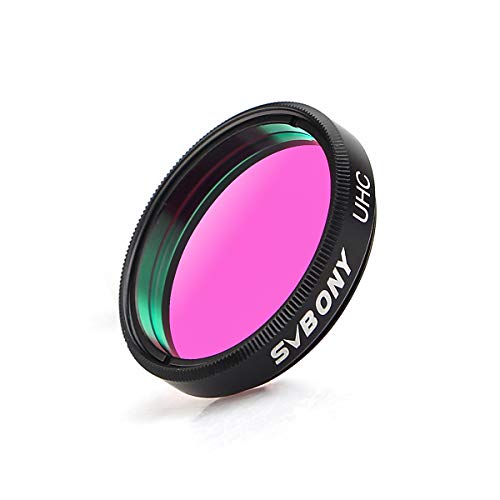
SVBONY 1.25 inch UHC Filter
A UHC passes the narrow emission lines of doubly ionised oxygen and hydrogen and blocks most of the rest, so it cuts sky glow far more than it cuts nebula light. Twenty eight dollars is little enough that trying it is a reasonable experiment even if your sky turns out not to need it.
Best for: Emission nebulae from a suburban garden, visually
Check price
Celestron Variable Moon Filter
Not a light pollution filter at all, and it is here because people buy one expecting the other. A variable polariser dials down lunar glare, which is a real problem at 8 inches and above, and it does nothing whatsoever for sky glow.
Best for: Lunar observing comfort, not light pollution
Check price
Optolong 2 inch L-Pro Light Pollution Filter
A broadband filter that notches out the sodium and mercury emission bands while passing most of the useful spectrum, so unlike a UHC it works on broadband targets such as galaxies and star clusters. It costs roughly a stop of throughput, which is worth paying under a suburban sky and pointless under a dark one.
Best for: Deep sky imaging from a light polluted site
Check pricePrices change often, confirm on Amazon. As an Amazon Associate we earn from qualifying purchases.
Which filter for which target?
The most useful way to hold this in your head is by target class rather than by filter name.
| Target | Spectrum | UHC | OIII | Broadband |
|---|---|---|---|---|
| Veil Nebula | Emission | Large gain | Dramatic gain | Small gain |
| Orion Nebula | Emission | Clear gain | Clear gain | Small gain |
| North America Nebula | Emission | Large gain | Moderate gain | Small gain |
| Ring Nebula | Planetary nebula | Moderate gain | Large gain | Small gain |
| Dumbbell Nebula | Planetary nebula | Clear gain | Large gain | Small gain |
| Andromeda Galaxy | Continuous | No gain | Makes it worse | Slight gain imaging only |
| Whirlpool Galaxy | Continuous | No gain | Makes it worse | Slight gain imaging only |
| Hercules Cluster | Continuous | No gain | Makes it worse | No gain |
| The Pleiades | Reflection | No gain | Makes it worse | No gain |
| Jupiter and Saturn | Continuous | No gain | No gain | No gain |
| The Moon | Continuous | No gain | No gain | No gain |
Read the bottom half and the conclusion follows: if the objects you most want to see are galaxies, clusters or planets, a light pollution filter is not the purchase. For planets and the Moon that is good news, because those are barely affected by light pollution at all, which is why city observers so often become planetary observers. For galaxies it is bad news, and the only real answers are aperture, patience and a darker sky.
How much does a filter actually buy you?
On the right target under the wrong sky, a great deal. A UHC under a Bortle 6 suburban sky can make the Veil Nebula visible where it was not visible at all, which is a larger practical change than any eyepiece upgrade. That is the case the filter exists for.
Set against the alternatives, though, the ranking is uncomfortable:
| Change | Cost | Gain on faint objects | Applies to |
|---|---|---|---|
| Drive to a Bortle 4 site | Fuel | About 2 magnitudes | Everything faint |
| Double the aperture | $700 or more | About 1.5 magnitudes | Everything |
| Full dark adaptation, 30 minutes | Free | About 1 magnitude | Everything faint |
| Observe seated rather than standing | $260 or improvise | About 0.5 magnitudes | Everything faint |
| A UHC filter | $28 | Large, on emission nebulae only | A narrow class of targets |
| A broadband filter, visually | $200 | Marginal | Very little, since LED lighting arrived |
The two free entries on that table are worth more than most equipment purchases and are the ones people skip. Dark adaptation takes twenty to thirty minutes of no white light at all, and a single glance at a phone resets it, which is why a red torch is on every one of our builds. Seated observation removes the tremor of standing and lets faint detail emerge, which typically takes twenty or thirty seconds of steady looking at the same spot.
What has changed now that streetlights are LED?
Broadband light pollution filters have become noticeably less useful, and it is worth understanding why before buying an expensive one on the strength of an older review.
Sodium and mercury vapour lighting emitted at a few narrow wavelengths, notably the sodium doublet around 589 nanometres. A broadband filter could notch those out and leave most of the rest of the spectrum untouched, which produced a real visible improvement. Modern white LEDs emit a broad continuum across the entire visible range, and there is no narrow band to notch. Any filter that meaningfully reduces LED sky glow also reduces the light from whatever you are looking at.
Narrowband filters are unaffected by this, because they work by passing a narrow band rather than by blocking a narrow band. A UHC or OIII still isolates the nebula lines exactly as well as it always did, regardless of what the streetlights are doing. That is why the cheap narrowband filter has aged better than the expensive broadband one.
For imaging the picture is different again, because a camera can integrate for hours and tolerate the light loss a filter imposes. An L-Pro style broadband filter costs roughly a stop of throughput and still improves the signal to noise ratio on broadband targets from a light polluted site, which is a trade that makes sense over a four hour integration and makes none at the eyepiece.
Who should not buy a filter?
Three groups, and being told so is more useful than being sold to.
- Anyone whose main interest is planets or the Moon. Light pollution barely affects bright targets, and no filter improves them. A variable moon filter is a comfort item for glare at large apertures, and it is not a light pollution filter despite frequently being sold alongside them.
- Anyone observing from a genuinely dark site. A UHC still raises contrast on emission nebulae under a dark sky, but the gain is modest because there was little sky glow to remove, and every filter costs some overall light.
- Anyone hoping a filter will rescue galaxy observing from a city. It will not, at any price, for the spectral reason set out above. That money is better spent on fuel to a darker site, or on an observing chair, or simply on the discipline of thirty minutes of proper dark adaptation.
If you are in none of those groups and you observe emission nebulae from a suburban garden, the UHC is one of the best value purchases in the hobby, and at under thirty dollars it is cheap enough that finding out costs very little.
Related pages
Frequently asked questions
Do light pollution filters actually work?
On emission nebulae, genuinely yes, and the effect can be dramatic. On galaxies, star clusters, planets and the Moon, no, and no filter ever will. Emission nebulae glow at a few specific wavelengths that a filter can isolate. Galaxies emit across the whole visible spectrum, so any filter that blocks sky glow blocks the galaxy by the same amount, and the contrast between them is unchanged.
What is the difference between a UHC and an OIII filter?
Bandwidth. A UHC passes a band roughly 20 to 25 nanometres wide, covering both the hydrogen beta and the doubly ionised oxygen lines, so it works on most emission nebulae while keeping the field reasonably bright. An OIII passes only a band of about 10 nanometres around the oxygen lines, which gives a stronger effect on planetary nebulae and the Veil while making everything else considerably darker.
Will a filter help me see galaxies from the city?
No. This is the most common and most expensive misunderstanding about filters. A galaxy is billions of stars emitting across the whole spectrum, exactly like the sky glow you want to remove, so a filter dims both equally and the contrast between them does not change. The only things that help galaxies from a city are aperture, dark adaptation and driving somewhere darker.
Do LED streetlights change what a filter can do?
Yes, and not in our favour. Old sodium and mercury lighting emitted at a few narrow wavelengths that a broadband filter could notch out cleanly. Modern white LEDs emit a broad continuum across the whole visible range, which is much harder to block selectively. Narrowband UHC and OIII filters still work because they pass rather than block, but broadband light pollution filters have become less effective as lighting has changed.
Is a filter better value than a bigger telescope?
For emission nebulae from a suburban site, often yes, because a $28 UHC can reveal targets that were invisible at any aperture from that location. For everything else, no. And both are beaten by the thing nobody wants to hear: driving 40 minutes to a Bortle 4 site buys about two magnitudes of reach, which is more than doubling the aperture achieves, and it costs fuel rather than money.
Do I need a 2 inch filter or will 1.25 inch do?
Match the filter to the eyepiece barrel you use most. Filters thread into the bottom of the eyepiece, so a 1.25 inch filter cannot be used with a 2 inch eyepiece. If you own both sizes and can afford only one filter, buy it for the low power eyepiece, because emission nebulae are large and low power is where a filter earns its money.
How we choose: we compare published manufacturer specifications, optical figures we can verify, and reviews from owners who have used the equipment under real skies. We do not test gear in person. Never point any telescope, finder or binocular at the Sun without a certified full-aperture solar filter fitted over the front of the instrument.
Recording your own eyepieces, exit pupils and sessions? The Observing & Astrophotography Planner is the paid version of these pages: 8 printable worksheets you fill in with your own numbers, plus the full PDF, $29.