Best Telescope for Beginners
The best telescope for most beginners is the Sky-Watcher Heritage 130mm Tabletop Dobsonian at $305, because its wobble-free tabletop mount solves the single biggest reason beginners quit, and 130 mm of aperture is enough to show Saturn's rings and real structure in the Orion Nebula.
A first telescope succeeds or fails on two things that have nothing to do with the number printed on the box: whether the mount holds the image steady, and whether the new owner knows ahead of time what a telescope will and will not show them. Get those two things right and a modest telescope becomes a lifelong hobby. Get either one wrong and an expensive telescope ends up in a closet by summer. The best all around choice is the Sky-Watcher Heritage 130mm Tabletop Dobsonian, a 130 mm reflector on the one mount design under $350 that does not wobble.
Why does the mount matter more than the telescope itself?
A cheap department store telescope on a wobbly mount is the single most common reason beginners give up on the hobby, and it is worth saying plainly before anything else on this page. Optics do not have to be excellent to be enjoyable. A mount does have to be steady, because a shaking image at 150x is unusable no matter how sharp the lens or mirror behind it is. The Moon jitters, Saturn smears into a blob, and a new owner reasonably concludes that telescopes do not work, when the actual problem was three thin aluminum tripod legs.
This is why a tabletop Dobsonian keeps winning this category. It has no tripod to flex: the tube sits directly on a rocker box, which sits directly on whatever table, stool or tailgate you put it on. A full sized refractor on a lightweight alt-azimuth tripod can be nudged into a wobble by wind or a heavy footstep nearby; a tabletop Dobsonian mostly cannot. If you already own a telescope that shakes, the honest fix is often a better mount rather than a better tube, and a Dobsonian rocker box mount is the simplest, steadiest option available at this budget.
What will a beginner telescope actually show you?
A telescope will not show you colorful nebulae the way photographs do. Human night vision runs almost entirely on rod cells at low light levels, and rods barely register color. The Orion Nebula, one of the brightest deep sky objects in the entire sky, looks like a patch of grey-green mist with a faint fan shape, not the crimson and teal cloud from a long exposure image. Galaxies beyond our own are dimmer still and mostly show up as soft grey smudges. Managing that expectation before the purchase, not after, is the single most useful thing this page can do.
What genuinely does look spectacular through the eyepiece, at almost any aperture on this page: the Moon, whose craters and mountain shadows hold up at every magnification a beginner telescope can reach; Saturn rings, visible as a separate disc from around 40x and showing the Cassini division by around 130x in steady air; Jupiter belts and its four bright Galilean moons, which visibly change position from one night to the next; globular clusters, which resolve into individual pinpoint stars in anything from 130 mm up; tight double stars; and the Pleiades open cluster, which looks like a fistful of blue diamonds in almost any instrument. Set those five targets as the goal for a first telescope and every option on this page delivers.
Which telescope should you actually buy, by budget?
Present the choices as a ladder rather than a single winner, because the right telescope depends on what obstacle you are solving: budget, aperture, or finding things in the first place.
Beginner telescopes by budget and mount type

Celestron FirstScope Signature Series Moon Tabletop
A 76 mm tabletop reflector sold as a gift item. It genuinely shows lunar craters and the four Galilean moons, and it genuinely will not show much else. Buy it as a present or a second grab and go, never as the telescope somebody is hoping for.
Best for: A child, or a very small budget with expectations set correctly
Check price
Celestron StarSense Explorer LT 80AZ
An 80 mm f/11 refractor, which is a long slow tube that behaves well on the Moon and planets and asks nothing of collimation. It is the cheapest thing in this list that is not a toy, and the honest limit is that 80 mm will not show you galaxies.
Best for: A tight budget where lunar and planetary viewing is the goal
Check price
Sky-Watcher Heritage 130mm Tabletop Dobsonian
A 130 mm mirror on a tabletop Dobsonian base, which is the only mount type under $350 that does not wobble. The collapsible tube drops it to something you carry outside one handed, and 130 mm is the smallest aperture that shows the Cassini division and real structure in the Orion Nebula.
Best for: A first telescope for an adult or a teenager, used from a garden or a car boot
Check price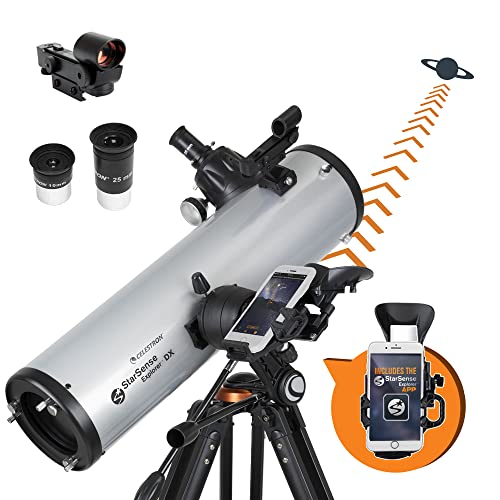
Celestron StarSense Explorer DX 130AZ
The same 130 mm f/5 optics as the tabletop, on a full tripod, with a phone dock that plate solves the sky and walks you onto the target with arrows. It is not a GoTo and nothing motorised moves, so no batteries and no alignment routine, but it removes the single thing that makes beginners quit.
Best for: Anyone in a light polluted suburb who cannot star hop yet
Check price
Celestron StarSense Explorer 130mm Tabletop
Plate solving phone guidance on a tabletop base, so there is no tripod to wobble and nothing to align. It needs a real table or a stool at the right height, which is the one thing tabletop buyers underestimate.
Best for: A first scope where the finding, not the aperture, is the obstacle
Check price
Sky-Watcher Classic 200 Dobsonian 8 inch
An 8 inch mirror is the classic answer for a reason: it gathers 2.4 times the light of a 130 mm, resolves globular clusters into individual stars, and shows the Cassini division on a mediocre night. The Dobsonian base is a box, which is why the money goes into glass instead of into a mount.
Best for: Visual observers who have somewhere to store a 40 lb tube
Check price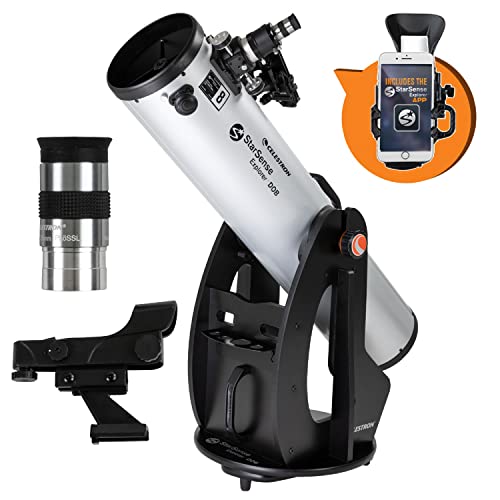
Celestron StarSense Explorer 8 inch Dobsonian
The 8 inch Dobsonian with the phone plate solving dock bolted on. You pay roughly $150 over the plain Classic 200 for the ability to find a galaxy you have never seen before on your first night out, which is a fair trade for most people.
Best for: An 8 inch buyer who does not want to learn the sky first
Check pricePrices change often, confirm on Amazon. As an Amazon Associate we earn from qualifying purchases.
The Celestron FirstScope and the StarSense Explorer LT 80AZ sit at the entry point: real optics, real limits, and both are honest about what a small budget buys. The Heritage 130P , the StarSense Explorer DX 130AZ and the StarSense Explorer 130mm Tabletop are all built around the same well proven 130 mm mirror, with the difference between them being tripod height and whether the phone dock plate solving system is included. At the top, the Sky-Watcher Classic 200P and the StarSense Explorer 8 inch Dobsonian step up to a genuinely different observing experience, at a genuinely different size and weight.
What actually comes in the box with a beginner telescope?
Every telescope on this page ships as a complete kit, not a tube that needs separate parts before it works. Expect the optical tube itself, the mount already built or requiring only simple tool-free assembly, two eyepieces covering a low and a medium magnification, and a simple finder for aiming the tube before you look through the main eyepiece. The StarSense models add the phone dock in place of, or alongside, a traditional finder. What is usually missing, and worth planning for even though it is not part of this page's picks: a red flashlight, and on the tripod mounted models, a set of anti-vibration pads that noticeably calm the image after every nudge.
The two eyepieces that ship in the box are almost always simple Kellner or modified achromat designs, which are perfectly usable and not the limiting factor for a first year or two of observing. Owners commonly assume better eyepieces will transform the view, and while a premium eyepiece does help at the margins, especially for eye relief and edge sharpness, it will not turn a 76 mm telescope into a 130 mm one. Aperture sets the ceiling; eyepieces decide how comfortably you reach it.
How much telescope is too much for a first purchase?
An 8 inch Dobsonian is not too much telescope optically, but it can be too much logistically for a first purchase. The Classic 200P weighs about 48 lb assembled and stands nearly four feet tall, and the StarSense 8 inch Dobsonian is close behind it. Neither one is heavy to lift once, but both need somewhere permanent to live: a garage corner, a spare closet, or a car boot that swallows a tube that size without a fight.
Two groups of people should not buy the 8 inch Dobsonian as a first telescope. Anyone who does not have a dedicated storage spot for a tube this size will find it becomes a chore to set up and an eyesore to store, and a telescope that is annoying to get outside gets used less, not more, regardless of how good the view is once it is out there. And anyone who has to carry it down a flight of stairs to reach an observing spot should not buy it either: 48 lb is manageable on flat ground and genuinely unpleasant on a staircase, done repeatedly, in the dark, holding a torch. Both groups are better served by a tabletop Dobsonian in the 130 mm class, which one person carries outside in a single trip without planning around it, and can upgrade to an 8 inch once the smaller scope proves the hobby sticks.
How much more do you actually get from an 8 inch mirror over a 130 mm one?
Aperture is measured by diameter, but light and resolving power scale by area, so the jump from 130 mm to 203 mm is bigger than the numbers alone suggest. Light gathering scales with the square of the aperture, so an 8 inch mirror collects about 2.4x the light of a 130 mm one for roughly 1.6x the physical diameter, at roughly 2.4x the price between the Heritage 130P and the Classic 200P.
| Telescope | Aperture | Price | Light vs. naked eye | Max useful magnification | Resolving limit (Dawes) |
|---|---|---|---|---|---|
| Celestron FirstScope 76 | 76 mm | $69.99 | 118x | 152x | 1.5" |
| StarSense Explorer LT 80AZ | 80 mm | $229.99 | 131x | 160x | 1.4" |
| Sky-Watcher Heritage 130P | 130 mm | $305.00 | 345x | 260x | 0.9" |
| Sky-Watcher Classic 200P | 203 mm | $725.00 | 841x | 406x | 0.6" |
Maximum useful magnification is a ceiling the atmosphere rarely lets you reach. Most nights cap out around 200x to 250x regardless of aperture, which is why the Classic 200P theoretical 406x is a number you will see used far less often than the 130P theoretical 260x.
Refractor, reflector or catadioptric: does the design matter for a first telescope?
For a first telescope, the practical difference is maintenance and mount, not raw quality. The two 130 mm Dobsonians on this page are Newtonian reflectors, which use a mirror and need occasional collimation, the process of aligning that mirror. It sounds intimidating and is not: a five minute check with a simple collimation cap, done a few times a season, is all a mirror this size typically needs. The StarSense Explorer LT 80AZ is a refractor, using a lens instead of a mirror, and refractors essentially never need collimation, which is part of why they are popular as low maintenance grab and go scopes despite costing more per millimeter of aperture.
What is the difference between the plain and StarSense versions of the same telescope?
Several telescopes on this page share the identical 130 mm f/5 optical tube and differ only in the base: a plain rocker box on the Heritage 130P, or a dock that holds your phone and plate solves the sky, drawing arrows that walk you onto a target, on the StarSense versions. Nothing motorized moves and no battery is required, so it is not a GoTo system, but it removes the single obstacle that stops most beginners from finding anything beyond the Moon in their first month: not knowing the sky yet. Learning to star hop by eye instead is entirely possible with a planisphere or a beginner's star atlas, and it saves the roughly $125 to $150 the StarSense dock adds, at the cost of a slower first few months finding things.
What should you buy alongside a first telescope?
Almost nothing, at first. Every telescope on this page ships with at least two eyepieces, which is enough to observe for months. The one accessory worth adding on day one is a red LED flashlight , since a white light phone screen or torch resets your night vision for ten to twenty minutes every time you check it, and red light preserves it almost entirely. It is a ten dollar purchase that changes how much you actually see for the rest of the night.
The second worthwhile early purchase is not equipment at all: a star chart or a beginner's guide to the sky. Turn Left At Orion is written specifically around what a small telescope can show and organizes targets by season, which turns a night of pointing at random stars into a night with a plan. Beyond a red light and a star chart, spend a season learning the sky before buying anything else: a second eyepiece or a finder is worth adding only once you know which magnifications and targets you actually reach for.
How long does it take before a beginner telescope feels easy to use?
Most new owners feel comfortable within two or three clear sessions, not one. The first night is almost always spent relearning how a telescope image works: everything appears upside down or mirror flipped depending on the optical path, the field of view is much narrower than it looks when you are pointing the tube by eye, and a target that seems easy to find by sight is surprisingly easy to lose once you are bent over the eyepiece. None of that is a sign anything is wrong with the telescope. Our first night guide walks through the setup and finding process in the order that actually reduces frustration, starting with the Moon rather than a faint deep sky target.
A plain Dobsonian without StarSense guidance takes longer to feel natural, typically a handful of sessions of deliberate star hopping before the sky starts to feel organized rather than random. That learning curve is real and it is also the entire point for observers who want to actually know the sky rather than have a phone app find it for them.
Related reading
- Best telescope under $500, every option at this budget compared
- Best Dobsonian telescope, the full aperture ladder up to 12 inches
- How to choose a telescope, the complete buying framework
- What can you actually see with a telescope, by object type
- How to use a telescope for the first time
- Telescope size calculator, match aperture to your storage and car
We review them on their own too, in full detail: the Sky-Watcher Heritage 130mm, the StarSense Explorer DX 130AZ and the Celestron AstroMaster 130EQ.
Frequently asked questions
What is the best telescope for a total beginner?
The Sky-Watcher Heritage 130mm Tabletop Dobsonian at $305. A 130 mm mirror is enough to show the Cassini division in Saturn rings and real structure in the Orion Nebula, and the tabletop Dobsonian base is the cheapest mount type that genuinely does not wobble. Set it on a patio table, a tailgate or a sturdy stool and it holds an image steady at high power, which is the one thing a first telescope has to do.
Should I buy a telescope from a department store or a toy aisle?
No. Most of those scopes pair a mediocre lens with a shaking EQ mount, and the mount ruins the view before the optics get a chance to. The Celestron PowerSeeker 127EQ is the textbook example: a spherical mirror that cannot be properly collimated by an owner, on a mount that shakes for several seconds after every touch. It is the single most returned telescope pattern in the hobby.
Will I see the colorful nebulae from the photographs?
No, and this is the most useful thing to know before you buy. Human night vision is nearly monochrome at low light levels, so the Orion Nebula looks like grey-green mist through any eyepiece, not like a long exposure photograph. Galaxies are faint smudges. What genuinely looks spectacular live: the Moon at any aperture, Saturn rings, Jupiter belts and four moons, globular clusters, double stars, and the Pleiades.
How much magnification do I need to see Saturn rings clearly?
Around 100x to 150x shows the rings clearly separated from the globe, and 150x to 200x starts resolving the Cassini division on a steady night. A 130 mm telescope has a maximum useful magnification of roughly 260x, so it comfortably reaches that range. Pushing past 250x rarely helps regardless of aperture, because the atmosphere itself blurs the image before the telescope runs out of resolving power.
Is an 8 inch Dobsonian too much telescope for a first purchase?
Optically no, logistically often yes. An 8 inch mirror gathers roughly 2.4 times the light of a 130 mm and resolves detail a 130 mm cannot, but the tube weighs around 48 lb and is about four feet long assembled. Anyone without a garage, a closet, or a car boot to store it in, and anyone who would have to carry it down a flight of stairs to get outside, is better served starting smaller and upgrading later.
What is the single biggest mistake beginners make buying a first telescope?
Judging the telescope by its magnification number on the box and ignoring the mount entirely. A cheap tube on a mount that shakes is unusable at anything past low power, and a shaking image at 150x looks broken even when the optics behind it are fine. The mount, not the tube, is what makes a telescope feel like a good or bad purchase in the first week of owning it.
How we choose: we compare published manufacturer specifications, optical figures we can verify, and reviews from owners who have used the equipment under real skies. We do not test gear in person. Never point any telescope, finder or binocular at the Sun without a certified full-aperture solar filter fitted over the front of the instrument.
Recording your own eyepieces, exit pupils and sessions? The Observing & Astrophotography Planner is the paid version of these pages: 8 printable worksheets you fill in with your own numbers, plus the full PDF, $29.