Best Dobsonian Telescope
The best Dobsonian telescope for most serious visual observers is the Sky-Watcher Classic 200 Dobsonian at $725, an 8 inch mirror on a simple rocker box mount that gathers roughly 2.4 times the light of a 130mm beginner scope for about 2.4 times the price.
A Dobsonian is a Newtonian reflector on the simplest mount that reliably holds it steady: a plywood box that turns side to side and up and down on smooth bearing surfaces, with no tripod, no motor and no counterweight. That simplicity is the entire selling point. The best all around Dobsonian is the Sky-Watcher Classic 200 Dobsonian at $725, an 8 inch mirror that puts nearly the whole budget into glass instead of into a mount.
What actually makes a telescope "a Dobsonian" rather than just a reflector on a simple stand?
The optical tube itself, a mirror at the back reflecting light up to a smaller secondary mirror that redirects it out to the eyepiece near the top, is a completely standard Newtonian reflector, identical in principle to the ones sold on equatorial mounts for imaging. What earns the Dobsonian name is entirely the mount underneath it: a rocker box that swings the tube side to side in altitude and up and down in azimuth on friction bearings, moved by hand rather than by a motor or a worm gear. That is a genuinely different design philosophy from every other mount type on this site, built around the idea that a large mirror on a dead simple mount beats a small mirror on an expensive one for pure visual observing.
Why is a Dobsonian the most aperture per dollar in the hobby?
Every telescope needs a mount capable of carrying its tube steadily, and mounts are expensive: machined bearings, slow motion controls, sometimes tracking motors and a hand controller. A computerized equatorial mount rated to carry an 8 inch Newtonian tube can cost as much as the tube itself, sometimes more. The Dobsonian mount design, invented by amateur astronomer John Dobson specifically to make large apertures affordable, replaces all of that with a box and two smooth bearing surfaces: a Teflon pad against laminate for the azimuth bearing, and a similar pad against the trunnion for altitude. It costs a small fraction of an equivalent equatorial mount, which means almost the entire purchase price buys mirror instead of machinery.
That is why the Sky-Watcher Classic 200P at $725 carries an 8 inch mirror, while a computerized German equatorial mount alone rated for a similar tube can cost more than $1,000 before a single inch of glass is added. Aperture, not the mount, is what determines how much you see, so a Dobsonian routes your money toward the part of the telescope that actually changes the view.
What do you give up by choosing a Dobsonian?
Two things, and both matter enough to say plainly before you buy. A plain Dobsonian has no tracking: nothing turns the telescope to follow the sky, so any target drifts out of the eyepiece within a minute or two at higher power and has to be nudged back by hand, forever, every session. This is a minor inconvenience for casual visual observing and a hard limit for astrophotography, which needs the mount to track continuously during an exposure. If imaging is the goal rather than looking through an eyepiece, a Dobsonian is the wrong telescope regardless of aperture, since imaging needs a mount that tracks continuously and no Dobsonian mount does.
A Dobsonian also has to live somewhere. The tube on the Classic 200P is roughly four feet long and the whole package weighs about 48 lb assembled. That is comfortable to carry in one trip across flat ground and genuinely unpleasant to carry down a staircase in the dark. Anyone without a garage, closet or car boot that swallows a tube that size without a fight should think hard before buying one, and our beginner telescope guide covers exactly who should start smaller instead.
Can you add tracking to a Dobsonian later?
Partially, and it is worth knowing before you buy rather than after. A phone based system like the one built into the StarSense Explorer 8 inch Dobsonian solves finding, not tracking: it points you at a target with a plate solving dock, and you still nudge the tube by hand to keep it centered once you get there. Separate from that, dedicated equatorial platforms exist that a Dobsonian rocker box sits on top of, tilting the whole assembly to track the sky for roughly an hour before needing to be reset. They add real cost and a second thing to set up and store, and they suit an owner who wants longer unaided views at high power or short exposure imaging without ever wanting the sharper tracking or the GoTo slewing of a full computerized mount. For most visual Dobsonian owners, this is a purchase to consider well after the telescope itself, not alongside it.
How do you transport and store a Dobsonian?
Most 8 inch and larger Dobsonians separate into two or three pieces for transport: the rocker box base, the optical tube, and sometimes a removable secondary cage or truss on collapsible designs. None of the telescopes on this page fold down small enough to disappear into a closet shelf, so plan real floor or shelf space rather than a drawer. A padded carrying case protects the tube during transport and makes an 8 inch scope meaningfully easier to load into a car without scuffing the mirror cell against a door frame, which is a more common source of minor damage than most new owners expect. Keeping a lightweight cover over the open tube between sessions, rather than fully breaking the scope down each time, is the difference between a Dobsonian that gets used every clear night and one that gets used once a month because setup feels like a project.
Which Dobsonian should you actually buy?
Aperture is the whole decision here, so the tiers below are organized by mirror size rather than by feature set, since a Dobsonian in this size range does not have many features to differentiate on beyond whether a phone based finding system is included.
Dobsonian telescopes by aperture

Sky-Watcher Heritage 130mm Tabletop Dobsonian
A 130 mm mirror on a tabletop Dobsonian base, which is the only mount type under $350 that does not wobble. The collapsible tube drops it to something you carry outside one handed, and 130 mm is the smallest aperture that shows the Cassini division and real structure in the Orion Nebula.
Best for: A first telescope for an adult or a teenager, used from a garden or a car boot
Check price
Sky-Watcher Classic 200 Dobsonian 8 inch
An 8 inch mirror is the classic answer for a reason: it gathers 2.4 times the light of a 130 mm, resolves globular clusters into individual stars, and shows the Cassini division on a mediocre night. The Dobsonian base is a box, which is why the money goes into glass instead of into a mount.
Best for: Visual observers who have somewhere to store a 40 lb tube
Check price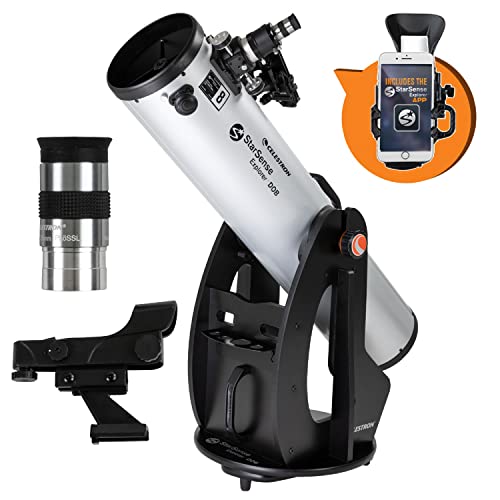
Celestron StarSense Explorer 8 inch Dobsonian
The 8 inch Dobsonian with the phone plate solving dock bolted on. You pay roughly $150 over the plain Classic 200 for the ability to find a galaxy you have never seen before on your first night out, which is a fair trade for most people.
Best for: An 8 inch buyer who does not want to learn the sky first
Check priceOrion SkyQuest XT6 Classic Dobsonian
A 6 inch f/8 Dobsonian, and the classic first full size Dob for a reason. The long focal ratio is forgiving on cheap eyepieces and steadier on planets than a faster mirror of the same size.
Best for: A full size Dobsonian one step below 8 inches
Find on AmazonApertura AD8 Dobsonian
An 8 inch Dobsonian that ships with a two inch dual speed focuser, a right angle finder, a cooling fan and a laser collimator already included, roughly $200 worth of accessories bundled into the price.
Best for: The best equipped 8 inch Dobsonian out of the box
Find on AmazonPrices change often, confirm on Amazon. As an Amazon Associate we earn from qualifying purchases.
How much more do you see at each step up in aperture?
Light gathering scales with the square of the aperture, not with the aperture itself, so each step up the Dobsonian ladder is bigger than the diameter change alone suggests.
| Aperture | Diameter | Light vs. naked eye | Resolving limit | Step up from previous |
|---|---|---|---|---|
| Tabletop (Heritage 130P) | 130 mm | 345x | 0.9" | baseline |
| 8 inch (Classic 200P) | 203 mm | 841x | 0.6" | 2.4x |
| 10 inch (Classic 250P) | 254 mm | 1317x | 0.5" | 1.6x |
| 12 inch (Classic 300P) | 305 mm | 1898x | 0.4" | 1.4x |
That table is also a caution about diminishing returns under a bright sky. Extra aperture keeps gathering more light regardless of where you observe from, but a light polluted background sky fights back against faint targets harder than a dark one does, so a step from 8 inches to 10 inches shows a much bigger jump from a rural site than it does from a city balcony. Checking your own sky against a light pollution scale before buying more aperture than your sky can use is worth five minutes, and a light pollution filter or a dark sky trip often does more for faint targets than the next size up in mirror does from a bright location.
What about the 10 inch and 12 inch Dobsonians?
The Sky-Watcher Classic 250P, a 10 inch mirror priced roughly $900 to $1,100, and the Sky-Watcher Classic 300P, a 12 inch mirror priced roughly $1,600 to $1,900, do not currently have a verified Amazon listing, so the links above go to their full specification pages rather than a product card here. Both are worth understanding even without a buy button, because they mark where the Dobsonian format changes character.
The 250P gathers roughly 1.6x the light of the 200P, which is the first step on this ladder that is obviously different at the eyepiece rather than merely measurable on paper: fainter galaxies resolve real structure instead of staying a grey smudge. It is also the point where the tube stops fitting easily in a small hatchback. The 300P gathers a further 1.4x on top of that and weighs around 90 lb assembled, which is a two person or two trip carry for most owners. Spiral arm structure in brighter galaxies like M51 and M81 becomes genuinely visible under a dark sky at 12 inches, which is the reason dedicated deep sky observers stretch to this size despite the storage and transport cost.
Who should not buy a 10 inch or 12 inch Dobsonian: anyone observing mainly from a city or bright suburb, since light pollution caps how much of that extra aperture you can actually use on faint targets; anyone without a fixed observing site or a vehicle that swallows a four to five foot tube in one trip; and anyone who has not yet owned and regularly used an 8 inch, since the jump in setup effort is real and is easiest to judge from experience with the size below it.
How much does a Dobsonian actually cost to own after the purchase price?
Very little, which is part of the format's appeal. There is no periodic alignment procedure costing money, no tracking motor to eventually service, and no battery required for the mount itself, since it moves entirely by hand. The recurring costs that do show up over a few years of ownership are modest: an occasional replacement of the primary mirror clips or springs if they loosen, a can of compressed air and an optical cleaning kit for dust on the mirrors, and eventually a mirror recoating if the reflective coating visibly degrades, which typically takes a decade or more of normal use rather than being a near term concern for a new purchase. Compared to a computerized mount with motors, encoders and a hand controller that can fail electronically, a Dobsonian's ongoing cost of ownership is about as low as a telescope gets.
Should you buy from a dealer instead of Amazon?
The Orion SkyQuest XT6 Classic , a 6 inch f/8 Dobsonian, and the Apertura AD8 , an 8 inch Dobsonian bundled with roughly $200 of accessories, both sell primarily through telescope dealers like High Point Scientific, Agena and OPT rather than through Amazon. That is normal for this category, not a red flag: those dealers assemble and quality check Dobsonians before shipping, which matters for a mirror this size. The links above search Amazon honestly for whichever listing exists rather than pointing at a fabricated product page.
What comes in the box with a Dobsonian, and what should you add first?
Every Dobsonian on this page ships as a working telescope: the optical tube with its mirrors already installed and roughly collimated at the factory, the rocker box base, and typically two eyepieces covering a low and a medium magnification. The StarSense models add the phone dock in place of a simple finder. What is worth adding early rather than assumed included: a proper finder if the stock one is a basic red dot rather than a magnified unit, since aiming an 8 inch tube precisely by eye alone gets harder as the field narrows at higher power, and a red flashlight for the same reason it matters on every other telescope on this site.
The single most valuable early upgrade specific to a Dobsonian is a wider field eyepiece for scanning, since the stock low power eyepiece on most of these telescopes has a narrower apparent field than the format rewards. A Dobsonian without tracking benefits disproportionately from a wide true field, because a wider field keeps a target in view longer between manual nudges. That single change does more for the day to day experience of owning one of these telescopes than almost any other accessory purchase.
Do Dobsonians need collimation?
Yes, all of them, since every Dobsonian on this page is a Newtonian reflector using two mirrors that must stay precisely aligned. It sounds more intimidating than it is: most owners check collimation in under five minutes before an observing session using a simple collimation cap or laser collimator, and a mirror that has not been jolted in transit rarely needs more than a small tweak. The full walkthrough is in our Newtonian collimation guide.
Related reading
We review them on their own too, in full detail: the Sky-Watcher Classic 200, the Classic 250 and the Heritage 130mm.
Frequently asked questions
What is the best Dobsonian telescope overall?
The Sky-Watcher Classic 200P at $725 for most serious visual observers. An 8 inch mirror gathers roughly 2.4 times the light of a 130 mm beginner scope and resolves globular clusters into individual stars rather than fuzz. The simple rocker box mount means almost the entire budget goes into the mirror rather than into motors or a tripod, which is the whole argument for buying a Dobsonian in the first place.
Why is a Dobsonian the most aperture per dollar you can buy?
Because the mount is a plywood or particleboard box with two smooth bearing surfaces, not a machined tripod head with slow motion gearing or tracking motors. An equatorial or GoTo mount rated to carry the same tube often costs as much as the tube itself. A Dobsonian moves that entire budget into glass, which is why an 8 inch Dobsonian and an 8 inch telescope on a computerized mount can differ in price by a factor of two or more.
What do you give up by buying a Dobsonian instead of a GoTo telescope?
Tracking and imaging, mainly. A plain Dobsonian has no motor, so any target you are looking at drifts out of the eyepiece within a minute or two at high power and has to be nudged back by hand. That rules out long exposure astrophotography, which needs the mount to track the sky continuously. It does not rule out casual phone snapshots of the Moon, which do not need tracking.
Is a StarSense Explorer Dobsonian worth the extra money over a plain one?
For most first time 8 inch buyers, yes. The StarSense Explorer 8 inch Dobsonian costs roughly $150 more than the plain Classic 200P and adds a phone dock that plate solves the sky and points you at targets. If you already know the sky or enjoy learning it by star hopping, the plain Classic 200P performs identically at the eyepiece and saves the money.
How much bigger is a 10 inch or 12 inch Dobsonian than an 8 inch?
A 10 inch mirror gathers roughly 1.6 times the light of an 8 inch, and a 12 inch gathers roughly 1.5 times the light of a 10 inch, so the jump compounds fast. The 12 inch also nearly doubles the weight and length of the 8 inch, becoming a two trip carry for most people. It is the point where spiral structure in brighter galaxies starts becoming visible under a dark sky, which an 8 inch mostly cannot show.
Who should not buy an 8 inch or larger Dobsonian?
Anyone without a dedicated storage spot for a tube in the 40 to 90 lb range, anyone who has to carry it down stairs to observe, and anyone observing mainly from a heavily light polluted city, where extra aperture on faint deep sky targets returns less than it would under darker skies. All three groups get more actual use out of a smaller, easier to deploy telescope.
How we choose: we compare published manufacturer specifications, optical figures we can verify, and reviews from owners who have used the equipment under real skies. We do not test gear in person. Never point any telescope, finder or binocular at the Sun without a certified full-aperture solar filter fitted over the front of the instrument.
Recording your own eyepieces, exit pupils and sessions? The Observing & Astrophotography Planner is the paid version of these pages: 8 printable worksheets you fill in with your own numbers, plus the full PDF, $29.