Best Telescope for Kids
The best first telescope for a child is the Celestron FirstScope Signature Series at $69.99, a 76mm tabletop reflector that genuinely shows lunar craters and the four Galilean moons of Jupiter, bought with the honest expectation that it will not show colorful nebulae and that binoculars are sometimes the better gift entirely.
Buying a telescope for a child goes wrong in two very specific ways, and both are avoidable before the box is even opened. The first is a wobbly mount: a shaking image at high power looks broken to a child with no frame of reference for what a steady view should look like, and a telescope that seems broken on the first try rarely gets a second one. The second is unmanaged expectations: the Moon is the star of the show, not the colorful nebulae from the photographs, and a child promised the photographs will be disappointed by the real eyepiece view no matter how good the telescope is. For most families, the safest first purchase is the Celestron FirstScope Signature Series at $69.99, a genuinely low-stakes gift with a mount that does not wobble and honest limits that are easy to set expectations around in advance.
What will a kids telescope actually show, and what will it not?
A telescope will not show a child colorful nebulae the way photographs do. Human night vision runs almost entirely on rod cells at low light levels, and rods barely register color, so the Orion Nebula looks like a patch of grey-green mist rather than the crimson and teal cloud from a long exposure photograph. Setting that expectation before the telescope comes out of the box, not after a disappointed first night, is the single most useful thing this page can do for a family buying a first telescope.
What genuinely does look spectacular to a child at the eyepiece, on every telescope on this page: the Moon, whose craters and mountain shadows hold up at any magnification these telescopes reach and change night to night as the phase shifts; Jupiter's four bright Galilean moons, visibly different in position from one night to the next, which reliably gets a reaction even from a very young observer; and Saturn's rings, visible as a separate disc once you reach the aperture of the intermediate tier below. Set the Moon as the goal for a first session specifically, not a random faint target, and the first night has a real chance of landing well.
Should you buy a telescope at all, or are binoculars the better gift?
Binoculars are often the better first gift, and it is worth saying plainly before recommending any telescope. A telescope needs assembly, collimation care on a reflector, and a finding technique a child has to be taught and practice; a pair of binoculars needs none of that. A child can pick the Celestron SkyMaster 15x70 up, look at the Moon, the Pleiades or a bright planet, and put them back down without anything to knock out of alignment or break. At 15x they genuinely benefit from a tripod or a steady rest for anyone, child or adult, but as a first gift into astronomy that asks almost nothing of the child using it, binoculars are hard to beat at this price.
Which telescope should you actually buy, by age and budget?
Present these as a ladder tied to interest level and independence, not just price, because a telescope a child cannot yet carry and aim on their own is a telescope that becomes a parent's chore rather than a child's hobby.
Kids telescopes and binoculars by age and interest

Celestron FirstScope Signature Series Moon Tabletop
A 76 mm tabletop reflector sold as a gift item. It genuinely shows lunar craters and the four Galilean moons, and it genuinely will not show much else. Buy it as a present or a second grab and go, never as the telescope somebody is hoping for.
Best for: A child, or a very small budget with expectations set correctly
Check price
Celestron SkyMaster 15x70 Astronomy Binoculars
Seventy millimetre objectives at 15x, which shows the Andromeda galaxy, the Pleiades and dozens of open clusters from a suburban garden. At 15x they need a tripod or a fence post, and anyone who tells you otherwise has not held them for ten minutes.
Best for: Learning the sky before spending telescope money
Check price
Sky-Watcher Heritage 130mm Tabletop Dobsonian
A 130 mm mirror on a tabletop Dobsonian base, which is the only mount type under $350 that does not wobble. The collapsible tube drops it to something you carry outside one handed, and 130 mm is the smallest aperture that shows the Cassini division and real structure in the Orion Nebula.
Best for: A first telescope for an adult or a teenager, used from a garden or a car boot
Check price
Celestron StarSense Explorer 130mm Tabletop
Plate solving phone guidance on a tabletop base, so there is no tripod to wobble and nothing to align. It needs a real table or a stool at the right height, which is the one thing tabletop buyers underestimate.
Best for: A first scope where the finding, not the aperture, is the obstacle
Check price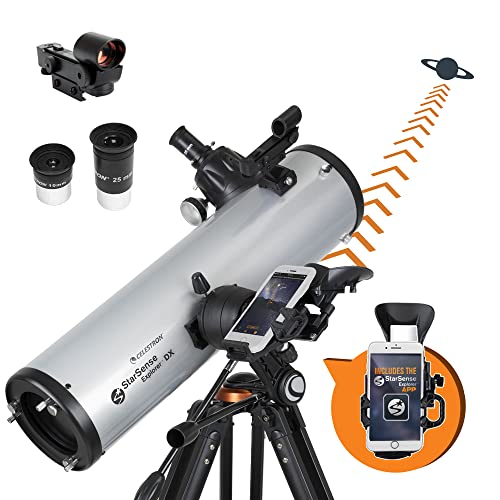
Celestron StarSense Explorer DX 130AZ
The same 130 mm f/5 optics as the tabletop, on a full tripod, with a phone dock that plate solves the sky and walks you onto the target with arrows. It is not a GoTo and nothing motorised moves, so no batteries and no alignment routine, but it removes the single thing that makes beginners quit.
Best for: Anyone in a light polluted suburb who cannot star hop yet
Check pricePrices change often, confirm on Amazon. As an Amazon Associate we earn from qualifying purchases.
The Celestron FirstScope and the SkyMaster 15x70 binoculars sit at the entry point: real optics, honest limits, and both cheap enough that a lukewarm reaction is not an expensive disappointment. The Heritage 130P and the StarSense Explorer 130mm Tabletop step up to a telescope that keeps satisfying genuine interest for years, still on a tabletop base that does not need a full tripod to stay steady. At the top, the StarSense Explorer DX 130AZ moves to a full tripod with phone-guided plate solving, aimed at a child who has already shown sustained interest and enough independence to manage a heavier, taller setup.
Who should not buy the expert tier?
A child who has not yet spent a season with a smaller telescope, and any family not ready to closely supervise a full tripod setup, should not start with the StarSense Explorer DX 130AZ. It trades the low, stable tabletop base of the tier below it for a full height tripod, which is genuinely capable but also easier to bump, tip or leave unbalanced than a tabletop scope sitting directly on solid ground. It also costs roughly 6.4x the FirstScope, a real amount of money to risk on a first telescope for a child whose interest is still unproven. Start smaller, let interest prove itself across a season of actual use, and treat the DX 130AZ as the reward for that interest rather than the opening gift.
How much more does a bigger kids telescope actually show?
Aperture is measured by diameter, but light gathering scales with the square of it, so the jump from the FirstScope's 76mm mirror to the 130mm mirror shared by the Heritage 130P and the StarSense models is bigger than the raw numbers suggest.
| Telescope | Aperture | Price | Light vs. naked eye |
|---|---|---|---|
| Celestron FirstScope | 76 mm | $69.99 | 118x |
| Sky-Watcher Heritage 130P | 130 mm | $305.00 | 345x |
| StarSense Explorer 130mm Tabletop | 130 mm | $429.95 | 345x |
| StarSense Explorer DX 130AZ | 130 mm | $449.99 | 345x |
The 130mm mirror shared by the intermediate and expert tiers gathers roughly 2.9x the light of the FirstScope's 76mm mirror, at roughly 1.7x the physical diameter. That is the difference between a Moon-and-Jupiter telescope and one that also resolves the Cassini division in Saturn rings.
How do you keep a child safe around a telescope during the day?
The single highest-risk combination in this hobby is a child, a telescope, and the Sun, because a telescope concentrates sunlight by a large factor and a young observer may not understand why a quick daytime look through an unfiltered eyepiece is dangerous rather than merely bright. Keep any telescope capped or pointed well away from the Sun whenever it is not being actively supervised outdoors, teach a child explicitly that the telescope is never pointed anywhere near the Sun without an adult present, and never allow a child to look through, or use as a hand-held sighting tool, the small finder scope mounted on top of the main tube, since it focuses the same danger into an even smaller opening. None of the telescopes on this page ship with a solar filter, and none should be pointed at the Sun without one specifically rated for full-aperture solar use.
What should you buy alongside a first kids telescope?
Very little at first, and nothing expensive. A red LED flashlight is worth adding on day one: a phone screen or white flashlight resets night vision for ten to twenty minutes every time it is checked, which is especially disruptive for a child who wants to look, check something, and look again. A simple planisphere star wheel turns "point the telescope at something" into a small, repeatable game a child can run themselves once shown how, and it works without batteries or a screen, which keeps a young observer looking up instead of down at a device.
Turn Left At Orion is worth adding once a child is old enough to read it, or as a parent's reference to plan a session before heading outside; it organizes targets by season around exactly what a small telescope can show, which keeps a session focused on objects that will actually reward the effort of finding them.
How do you set expectations before the first night outside?
Tell a child directly, before looking through anything, that the Moon is the best target a first telescope will show and that most other objects will look like faint grey smudges rather than the colorful photographs. Start the first session on the Moon itself, ideally at a partial phase when shadows along the crater rims add visible texture, rather than a full Moon, which looks flatter and less dramatic through an eyepiece. Move to Jupiter or Saturn next if either is up, since watching Jupiter's moons change position across a few nights is one of the most reliably engaging follow-up activities for a young observer. Save faint deep sky targets like galaxies and nebulae for later sessions, once the initial expectation has already been set correctly by the Moon and planets.
How much assembly and setup does a kids telescope actually need?
Every telescope on this page ships largely pre-assembled or requiring only simple, tool-free setup: the tabletop Dobsonians need the tube seated in the rocker box and a finder attached, and the StarSense DX 130AZ needs its tripod legs extended and the tube mounted, both jobs a parent can do once in a few minutes. None of the telescopes here need collimation adjusted before first use, though the Newtonian designs, the FirstScope and the two 130mm Dobsonians, benefit from an occasional collimation check as they get bumped and transported over a season of use. See our first night guide for a walkthrough written for a first-time user of any age.
Related reading
- Best astronomy binoculars, the full binocular comparison
- How to observe the Sun safely, required reading before any daytime use
- Best solar filter for telescope, certified full-aperture options
- What can you actually see with a telescope, by object type
- How to use a telescope for the first time
Frequently asked questions
What is the best telescope for a child?
The Celestron FirstScope Signature Series at $69.99 for a first, low-stakes gift, or the Sky-Watcher Heritage 130mm Tabletop Dobsonian at $305 if the goal is a telescope that keeps satisfying a genuinely interested child for years. The FirstScope shows real lunar craters and the four Galilean moons and little beyond that; the Heritage 130P shows Saturn rings and structure in the Orion Nebula, at a real jump in price.
Will a kids telescope show colorful nebulae like the photos?
No, and setting this expectation before the gift is opened matters more than any spec on the box. Human night vision is nearly monochrome in low light, so the Orion Nebula looks like grey-green mist, not a photograph, through any telescope on this page. The Moon is genuinely spectacular at any aperture here, and that is the honest sell: set the Moon as the star of the first night, not a nebula.
Should I buy binoculars instead of a telescope for a child?
Often, yes. A pair of astronomy binoculars needs no assembly, no collimation and no finding technique beyond pointing them, and a child can pick them up and put them down freely without anything to knock out of alignment. The Celestron SkyMaster 15x70 shows the Pleiades, the Andromeda galaxy and dozens of star clusters, and it is a genuinely better first gift than a wobbly department store telescope at a similar price.
What ruins a first telescope experience for a child fastest?
A wobbly mount, more than any other single factor. A shaking image at high power looks broken to a child who has no context for what a steady view should look like, and a telescope that seems broken on night one rarely gets a second try. Every telescope on this page uses a mount type that does not wobble at the magnifications a child is likely to use.
Is it safe for a child to use a telescope during the day?
Only pointed away from the Sun. A telescope concentrates sunlight by the ratio of its aperture to the pupil of an eye, and even a brief accidental glance at the Sun through an unfiltered telescope, finder or binocular can cause instant, permanent and painless blindness. Supervise daytime use closely, keep the telescope capped or pointed at the ground when not actively supervised, and never rely on a child alone to keep it away from the Sun.
When should a child move up from a tabletop scope to a full tripod scope?
Once they can carry, aim and adjust the smaller scope on their own and have shown sustained interest across at least a season of use, typically somewhere around age nine or ten depending on the child. The StarSense Explorer DX 130AZ trades the low, stable tabletop base for a full tripod and a heavier setup, which asks more independence and care than a younger or newer observer usually has yet.
How we choose: we compare published manufacturer specifications, optical figures we can verify, and reviews from owners who have used the equipment under real skies. We do not test gear in person. Never point any telescope, finder or binocular at the Sun without a certified full-aperture solar filter fitted over the front of the instrument.
Recording your own eyepieces, exit pupils and sessions? The Observing & Astrophotography Planner is the paid version of these pages: 8 printable worksheets you fill in with your own numbers, plus the full PDF, $29.